

Updated Wed April 15, 2026
Published Under: Enterprise
Modern businesses rely on technology to keep operations moving. Customer data lives in CRMs. Financial and operational data runs through ERPs. Documents and files are stored across shared drives and internal platforms. Teams use a mix of tools to manage daily work.
Individually, these systems may work well. Collectively, they often do not.
As organizations grow, their technology stacks grow with them. New systems are added to solve specific needs, but over time those tools begin operating in isolation. The result is a collection of platforms that require manual effort to keep information aligned.
That is when work starts to slow down.
The Hidden Cost of Disconnected Business Systems
When systems do not communicate with each other, inefficiencies quietly become part of everyday operations.
-
Data gets entered more than once.
-
Teams jump between platforms to complete a single task.
-
Processes take longer than they should.
-
Visibility across systems becomes limited.
What often goes unnoticed is how much time and effort this manual work consumes. Employees spend hours re‑entering information, searching for documents, or reconciling data across systems. Small inefficiencies compound into meaningful operational drag.
Over time, these challenges can impact accuracy, decision‑making, and employee satisfaction.
Why Disconnected Workflows are so Common
Most organizations do not set out to create inefficient workflows. In many cases, disconnected systems are the natural result of growth.
A CRM is implemented to manage sales activity. An ERP supports financial and operational needs. Teams rely on spreadsheets or internal tools to fill workflow gaps. Platforms such as Salesforce, Oracle, Microsoft systems, and custom applications are adopted at different stages of growth.
Each decision makes sense on its own.
The challenge emerges when those systems are never designed to work together.
Without intentional system integration, information becomes siloed. Processes vary by department. Teams rely on manual steps to bridge the gaps between platforms. The business adapts, but efficiency suffers.
Manual Work is a Signal, not a Solution
Many organizations accept duplicated work and platform hopping as the cost of doing business. In reality, these are signals that underlying workflows need attention.
Manual processes introduce risk. The more times data is re‑entered, the greater the chance of errors. The more systems employees must navigate, the harder it becomes to maintain consistency and accountability.
Manual workflows also limit scale. Processes that rely heavily on spreadsheets or disconnected tools often struggle to keep pace as teams grow and operations become more complex.
Integration Does Not Mean Replacing Everything
When organizations recognize these challenges, the first assumption is often that systems need to be replaced. That is rarely the case.
In many situations, the most effective path forward is workflow integration, not replacement.
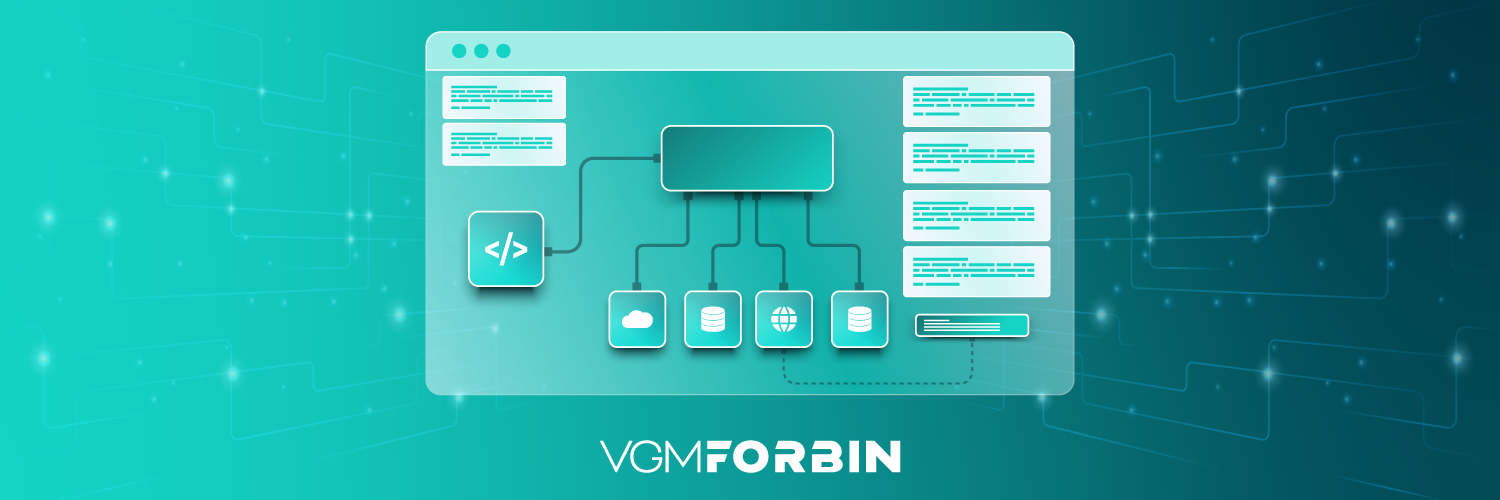
System integration focuses on connecting existing platforms so data can move seamlessly between them. Instead of asking teams to manage multiple systems, integration allows information to flow automatically and supports end‑to‑end workflows.
This approach preserves prior technology investments while reducing manual effort.
Where VGM Forbin Adds Value
VGM Forbin helps organizations design and build business application workflow integrations that close gaps between systems and reduce operational friction. Our team works with CRMs, ERPs, and custom business applications to create solutions that fit how a business actually operates.
What sets VGM Forbin apart is not just technical expertise, but how we approach the work.
We start with discovery and scope, working closely with stakeholders to understand how work truly flows across departments. From there, we design integrations that simplify processes instead of adding complexity.
Our team brings experience with enterprise platforms, including Oracle environments, and delivers solutions through a 100 percent U.S.‑based team. We provide implementation, training, and post‑launch support, ensuring teams are confident using the systems long after launch.
As a one‑stop partner, VGM Forbin supports enterprise operations across digital, technology, and integration needs. This allows organizations to work with a smaller, focused team that acts as an extension of their own.
What Connected Systems Make Possible
When systems are intentionally integrated, everyday work begins to change.
-
Data flows automatically between platforms.
-
Teams complete tasks from a centralized experience.
-
Leaders gain clearer visibility into operations.
Rather than managing software, employees can focus on meaningful work. Decisions are made with better information. Bottlenecks become easier to identify and resolve.
The goal is not more technology. The goal is clarity.
A Better Foundation for Growing Organizations
For mid‑to‑large businesses, efficiency is not just about speed. It is about accuracy, scalability, and sustainability. Disconnected systems create friction that becomes harder to ignore as organizations expand.
Connecting systems creates a foundation for smarter workflows, cleaner data, and more confident decision‑making. It allows businesses to simplify operations without disrupting what already works.
When systems work together, teams do too.
Is This Your Business
If your organization is dealing with duplicate data entry, disconnected platforms, or inefficient workflows, it may be time to take a closer look at how your systems interact.
The biggest gains often come not from adding another tool, but from connecting the ones you already rely on.
Learn more about enterprise workflow integrations or connect with our team to talk through your systems and challenges.
Comments